

Coin Holders
We buy coins to look at them, and the coin holders through which we look can greatly affect our viewing pleasure. It's common knowledge that there's no such thing as the perfect coin holder, but that's never stopped coin collectors from searching the best coin holder for them.
Much about coin holders is subjective. My preferences regarding the best coin holder may be different from yours. What follows resulted from talking with coin collectors, coin supply dealers, coin holder wholesalers, and coin holder manufacturers, as well as my own experiences in testing out or using each of these holder types.
Your choices in coin holders include but aren't limited to the following, in order of estimated popularity:
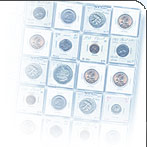
 These holders consist of white cardboard with a clear Mylar pocket to let you view the coin. You can attribute and describe coins on the cardboard with pen or pencil. These holders are called 2x2s because the holder's dimensions measure 2 inches by 2 inches, though most coin holders are this size as well. (In Europe larger and smaller sizes are used more commonly than they are in the U.S. )
One problem with 2x2s is that paper dust from the cardboard can cause spotting over time. Some holders, however, advertise that they're dust free.
The staples on the staple-type holders can potentially scratch a coin if you're not careful when removing it or rust and leach chemicals onto coins.
The adhesive on self-sealing 2x2s can potentially damage coins over time, and the adhesive can wear out as well, causing the holder to pop open.
2x2s are somewhat chintzy looking, but they're inexpensive, relatively safe, and popular. They're often used by coin dealers because of their low cost and because it's easy to write on them.

With these all-plastic two-part holders, you flip up the part of the holder holding the coin to view the coin's reverse. You can choose flips with one pocket (for the coin) or two pockets (one for the coin and the other for a paper insert on which you can attribute and describe the coin, optionally using a computer). Unlike many other holders, safety flips let you view edge of the coin. They're called "safety flips" because they're relatively safe for long-term coin storage.
There are two kinds of safety flips, generic safety flips and Kointain Saflips. Generic safety flips are made from low-plasticizer PVC. They're often mistakenly called non-PVC flips or PVC-free flips, even by some coin supply dealers, despite the fact that they're made of PVC, which is an abbreviation for the plastic with the name polyvinylchloride (or vinyl for short).
Generic safety flips are much safer than ordinary PVC flips for long-term coin storage because of their low levels of plasticizers (typically, phthalate esters). It's primarily the plasticizers used to soften the PVC, not the PVC itself, that can damage a coin's surfaces over time. Safety flips have as little as one-fifth the amount of plasticizers as ordinary PVC flips. Sometimes low-plasticizer PVC flips are mistakenly called unplasticized flips.
Generic low-plasticizer PVC safety flips aren't perfect. Their hard edges may scratch a coin when you insert or remove it if you're not careful. They may crack with repeated opening and closing, forcing you to replace the holder. They may turn pale color over time, also forcing you to replace them.
Generic safety flips shouldn't be used with proof coins because the PVC itself can degrade over long periods of time, releasing small quantities of gaseous chemicals, including hydrochloric acid, chloroethylene epoxide, and formic acid. These chemicals, in turn, can cause microscopic pitting on coins, leading to hazing on a proof surface. This outgassing occurs more if the holders are exposed to excessive humidity or sunlight. With circulated coins, these concerns are minimal.
There are several different kinds of generic safety flips. The Super Safe brand (sometimes called Madison coin flips since they're made by Frame-A-Coin of Madison, N.J.) are available at many coin shows and through Brent-Krueger Coin Supplies. They come in sheets -- you tear off the individual flips.
Other generic safety flips are made by International Plastics of Altadena, Calif., and are available from Jake's Marketplace. They're thicker and sturdier than the Super Safe flips (and they consequently make nice mini-coin stands), but they crack more easily and are thus not as practical for large coins.
Still other generic safety flips are made by various manufacturers in China , including those sold by Brooklyn Gallery Coins & Stamps.
Generic safety flips are attractive, relatively inexpensive, and popular. To reduce the chances of generic safety flips causing problems in coins over long periods of time, you should store coins in them away from excessive heat (less than 85 degrees F.) and humidity.
The other main type of safety flip is the Kointain Saflip. These flips are made from Mylar, which is one brand name for the plastic with the name polyethylene terephthalate. Mylar is thought to be somewhat safer over the long term than low-plasticizer vinyl. It's also not as prone to cracking.
One negative of Kointain Saflips are their horizontal striations, which are unsightly and can interfere with viewing of the coin inside. These flips also have sharp corners. Kointain Saflips are more expensive than generic safety flips but can be a good choice for proof coins and otherwise when safety is paramount.
 Flips, also called soft vinyl flips, PVC flips or
Insert Coin Envelopes, are commonly used by dealers to sell coins and by some grading services when people submit coins to them because they make it easy and safe to insert and remove coins from them and because they're inexpensive. However, regular flips are unsafe for long-term coin storage.
Flips, also called soft vinyl flips, PVC flips or
Insert Coin Envelopes, are commonly used by dealers to sell coins and by some grading services when people submit coins to them because they make it easy and safe to insert and remove coins from them and because they're inexpensive. However, regular flips are unsafe for long-term coin storage.
Flips consist of PVC (polyvinylchloride, also known as vinyl), stabilizers (to prolong life), and plasticizers (to soften the plastic). Plasticizers mixed with the PCV can damage coins over time, causing "PVC damage", which looks like green goo. Damage occurs faster when flips are exposed to excessive heat (above 85 degrees F.), humidity, sunlight, and mechanical bending. Early PVC damage can be removed with acetone. More severe PVC damage can corrode a coin's surfaces, causing permanent damage.
Theoretically, this damage can also occur with low-plasticizer PVC flips as well, though I've heard of only one instance of this happening, with a collector in Hawaii , a state with a warm and humid climate. On the other hand, some collectors have stored their coins in regular soft flips for decades without damaging them.
Still, it's only smart to play the percentages. If you buy a coin in a soft vinyl flip, you should remove it and place it in another storage medium. One rule of thumb is that no coin should sit in a soft flip for more than six months.
New evidence from PCGS suggests that inserting and removing heavier coins from soft flips can cause scratches on a small percentage of them as a result of small particulate matter imbedded in the surfaces of the flip.
Such particles can consist of iron, zinc, silicon, sulfur, chlorine, potassium, and calcium. PCGS suggests using Mylar flips when submitting coins to a grading service.


