

Coin Grading
Coin Grading Introduction: Coins are usually described by their country of origin, type, denomination, date, mint mark, variety and condition. With all but the last of these, there is rarely any ambiguity. However, with their state of preservation or condition, there often are differing opinions, so a standard system of grading coins has evolved which allows us to more clearly determine and communicate their relative quality.
Coins meant for use in daily commerce are referred to as "Business Strikes" and are generally mass-produced. In addition, Canada and other countries produce special pieces for official presentation or for collectors.
These "Specimens", "Proofs" and "Proof-Likes" are usually carefully produced from specially prepared dies, and are given special handling and packaging. These pieces are quite noticeably different in quality from business strikes, and are classified and collected separately from them.
Some of this material is being used under license from the Canadian Coinoisseur, inc.
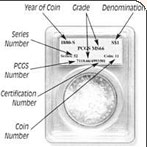
Coins Grades
Coin conditions / grades range from the poorest state, where neither the date nor the designs are discernible, to the best state where all of the elements of the design are as clear and detailed as they were when they were struck at the mint. The first objective in grading coins is to determine whether the coin is Mintstate or if it is Circulated -- or in plain words, whether it is new or used. Mintstate coins must have absolutely no visible signs of wear on any part of the coin's surface. They are not necessarily flawless, as the majority will have small marks (not wear), resulting from, among other things, contact with other coins in hoppers, bins and counting machines at the mint and in bags during distribution to the banks. Circulated coins will have varying degrees of surface wear as a result of handling.
There are no exact scientific means available to measure the surface condition of coins, so grading is an art that takes into account many factors, both objective and subjective. Coin grading involves much more than simply determining whether the coin has seen wear or not. With eleven different Mintstate grades to chose from, the grader must accurately assess the condition of the surfaces, the quality of the lustre and the fullness of the strike, as well as the interplay of these factors with each other. However, unlike with US coin grading, eye appeal is not a factor in the technical grading of Canadian coins. If there is particularly attractive toning which greatly enhances the eye appeal of the coin, for example, this fact is appended to the grade such as "with Great Eye Appeal" or "with Superb Eye Appeal".
With circulated coins, the amount of wear is the most important consideration. But the fullness of the strike, the amount and quality of the residual lustre, the condition of the surfaces, the general quality of the piece, and many other factors also lend an influence. Sometimes there is thick and obscuring toning which may hide small surface marks, evidence of cleaning or signs of wear. All of these factors make the complex task of grading more difficult, and since a great deal of human judgment is involved, we can expect there to be some differences of opinion on the precise grade of many coins.
When a coin's condition is determined it is assigned one of a range of Circulated or Mintstate grades according to generally accepted grading standards. Early standards for grading coins used as few as six descriptive or adjectival terms: Good, Very Good, Fine, Very Fine, Extremely Fine and Uncirculated, to describe grades. Today, with uncertified coins, a dozen or so grades are commonly seen, however, with Certified coins, at least fifteen grades are regularly used just to assess the circulated coins, while a further ten grades are used to designate the Mintstate coins, giving a total of more than twenty-five grades.
Coin Grading System and Standards
Historically, an adjectival system was virtually the only one used to grade coins, however, in the late 40's a numerical system was devised by an American, Dr. William Sheldon, using numbers from one to seventy. The circulated grades were assigned numbers from 1 to 59, while the numbers from 60 to 70 were used for the Mintstate grades. The basis of his number selection was the relationship of prices of early American copper coins with their grades. For example, in the late 1940's, the price of a typical Mintstate coin (MS-60) was about five times the price of a typical Fine (F-12) example of the same date and variety. It is important to note that both the adjectival and the numerical grading systems use the same grade definitions.
Sheldon's numerical system has been extended far beyond early American copper coins and is now the generally accepted standard for grading in most areas of North America. Not all of the numbers in the range are used, and the following are the more commonly seen numerical grades and their adjectival equivalents:
aG-3 About Good
G-4 Good
VG-8 Very Good
VG-10 Very Good Plus
F-12 Fine
F-15 Fine Plus
VF-20 Very Fine
VF-30 Very Fine Plus
EF-40 Extremely Fine
EF-45 Choice Extremely Fine
AU-50 About Uncirculated
AU-55 Choice About Uncirculated
AU-58 Very Choice About Uncirculated
MS-60 Typical Mintstate
MS-61 Typical Mintstate
MS-62 Select Mintstate
MS-63 Choice Mintstate
MS-64 Very Choice Mintstate
MS-65 Gem Mintstate
MS-66 Gem Mintstate
MS-67 Superb Mintstate
MS-68 Superb Mintstate
MS-69 Superb Mintstate
MS-70 Perfect Mintstate
Proofs, Proof-Likes and Specimens are designated with the prefixes PF, PL and SP, and further assigned a numerical grade: 60, 63, 65 and so on. Impaired pieces (those that have sustained wear through either mishandling or circulation) are assigned grades below 60, such as SP-55, and PF-50. Except in years or varieties where only Proofs or Specimens were issued, it is the exception to find a grade assigned below 50 since the surface and strike characteristics that are generally required for correct attribution are most likely gone.
See our Grading Minstate Coins and Grading Circulated Coins for grading samples and detailed descriptions.
World Coin Grading
Here's a useful conversion chart showing Coin Grading by different Coin grading systems:
| AMERICAN ADJECTIVAL GRADE | SHELDON'S NUMERIC GRADING | GERMAN COIN GRADING | ITALIAN COIN GRADING | FRENCH COIN GRADING |
| ABOUT GOOD | AG 3 | gering | bien conservée | |
| GOOD | G-4 to G-6 | gut | discreto (D) | très bien conservée |
| VERY GOOD | VG-7 to VG-11 | sehr gut | bello (B) | beau |
| FINE | F-12 to F-19 | schön (S) | molto bello (MB) | très beau (TB) |
| VERY FINE | VF-20 to VF-39 | sehr schön (SS) | bellissimo (BB) | très très beau (TTB) |
| EXTREMELY FINE | EF-40 to EF-49 | vorzüglich (VZ o VZGL) | splendido (SPL) | superbe (SUP) |
| ABOUT UNCIRCULATED | AU-50 to AU-59 | fast stempelglanz (VZ-ST) | fior di conio (FDC) | Fleur de coin (FDC) |
| UNCIRCULATED | MS-60 to MS-62 | bankfrisch or (BF) | ||
| CHOICE UNCIRCULATED | MS-63 | stempelglanz (ST o STGL) | ||
| SELECT UNCIRCULATED | MS-64 | |||
| GEM UNCIRCULATED | MS-65 to MS-66 | erstabschlag (EA) | ||
| SUPERB UNCIRCULATED | MS-67 to MS-70 | |||
| PROOF LIKE | PL | - | - | - |
| PROOF | PF | Polierte Platte (PP) | fondo specchio (FS) | Flan bruni |
Commercial, third-party grading has not been accepted by the Germans to any great degree. However, American collectors place a high degree of emphasis on quality, thus they actively seek the highest possible grade for a given coin. Thus, a certified coin is easier to sell to an American collector than a "raw" coin; the opposite is true when dealing with a German collector.
TopAncient Coin Grading
Following grading system was introducted by NGC Ancients:
| GRADE ABBREVIATION | GRADE | SHELDON SCALE EQUIVALENT |
| PR | Poor | 1 |
| FA | Fair | 2 |
| AG | About Good | 3 |
| G | Good | 4-6 |
| VG | Very Good | 8-10 |
| F | Fine | 12 |
| Ch F | Choice Fine | 15 |
| VF | Very Fine | 20-25 |
| Ch VF | Choice Very Fine | 30-35 |
| XF | Extremely Fine | 40 |
| Ch XF | Choice Extremely Fine | 45 |
| AU | About Uncirculated | 50-53 |
| Ch AU | Choice About Uncirculated | 55-58 |
| MS | Mint State | 60-62 |
| Ch MS | Choice Mint State | 63-64 |
| Gem MS | Gem Mint State | 65-70 |
Rather than Sheldon’s 70-point scale, NGC Ancients will use the adjectival system. In the circulated grades the terms will strictly describe the amount of wear a coin has suffered; however, in the uncirculated grades it will take into account the overall appearance of the coin to distinguish among Mint State, Choice Mint State and Gem Mint State.
TopWarning
Coins may be graded by someone with little or no grading skill or experience, or by a person trying to deceive. If you are buying uncertified coins, particularly sight-unseen, it is wise to determine the credentials of their grader, since inexperience or error on the part of the grader may lead to incorrect grading - and usually not in your favor. If you have no knowledge of the integrity nor of the skills and experience of the coin's grader, then it is wise to stick to buying Certified coins until your own grading skills are keenly honed. Until then, it is better to allow the reputation and integrity of the Certification Services, and their particular grading standards, be your protection.