

Gold Coins
Gold Coin Investment is becoming extremely popular investment with US$ losing it's reputation as a safe currency and investors choosing to put their money to gold, which increased 65% since 2001 and continues to grow. More and more investors recognizing gold coins market with it's low risk and high returns. See more about coin investment.
You can buy Russian Gold Coins at My Coin Dealer shop.
Visit our sister site Gold Coins Zone for information about gold coins.
Gold Coins Prices
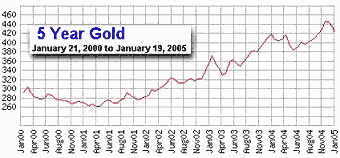
Gold coins prices had a steady increase in the last 5 years and US gold coins created a market sector, which is extremely liquid and monitored by thousands of investors and dealers. The prices of gold coins are affected by a lot of factors, the main are:
1) Bullion market value of gold : Gold coin value is greatly affected by price of the gold itself.

Source: World Gold Council
Sell also Gold Profit Report for Gold information.
2) Gold Coin Grade or quality: Gold coin value depends a lot on the coin grading. Gold coins in general stay well preserved and usually, even the difference in 1 grade makes coins 2-3 times more expensive
3) Rarity of the Gold coin - rare Gold coins are more valuable than more common gold coins, even if they look and grade identical and only differ in 1 year or by mint mark. You should pay close attention to the mintage of the coin. Usually price of the coins with lowest mintage will appriciate much faster than coins minted in high volumes.
4) Old coins vs Modern coins - Although older gold coins (pre 1933) will cost more than modern gold coins, their value appreciate faster than modern coins.
See Latest Gold Coin Prices page for latest gold and gold coin prices.
Please refer to the Coin Values page for more information about coin value.
Investment in Gold Coins
Investing in gold coins brought huge returns for some and disappointment for others. You can not expect to buy any gold coin and make good money in less than a year. There are gold coins, which increased more than 100% in value in last 5 years and there are some other, which haven't increased much or even lost some value in the gold bull market ! As in any market and coin market is not an exception, if you want to make money you should do your research and choose what you are buying carefully, unless coin collecting is just a hobby for you and you don't care about increase of the value of your collection.
TIPS: Don't bother buying any modern gold coins (post 1933), you will have much higher returns with older coins. The price of modern coins is highly linked to the bullion price of the gold. Older gold coins have high demand from collectors and this demand only grows.
Also, try to stick with AU-58 and MS-62 graded by NGC or PCGS (learn more about Grading Coins), avoid not graded gold coins.
Please refer to our Coins Investment page for more information about Investing in coins.
Gold Coins History
The first coins containing gold were struck in western Asia Minor in the late eighth century BC. They were made from electrum , a natural alloy of gold and silver found in the rivers of the region, and had a design on one face and a punch mark or seal on the other. The introduction of pure gold and silver coins is generally attributed to the Lydian king Croesus (561-546 BC).
Thereafter, gold, silver and copper coins came into increasing usage as a means of exchange. But silver was usually pre-eminent, simply because most early communities did not have enough gold at hand for it to become commonly used as a currency; only in such civilizations such as Mycenae was gold widely used.
The Greek and Roman empires used gold coinage relatively rarely and it became increasingly debased as their empires waned. In the Middle Ages, silver was the standard coinage, although gold coins were regularly minted in the Italian city states of Florence , Genoa and Venice that were the crossroads of medieval trading routes.
The immense riches of the New World , revealed in the second half of the sixteenth century, also confirmed silver's role. Silver ¥pieces of eight' ( reale de a ocho ) from the mints of Mexico City and Potosi came to dominate European coinage. Although the Americas produced some gold, no wide coin circulation was achieved until the early eighteenth century when significant gold discoveries in Brazil provided Portugal with the metal to mint its Moedas de Oro then used to pay for English wool.
The flow of these gold coins into London was one reason that gold coinage could proliferate in Britain in the eighteenth century. It was encouraged, too, because from the recoinage of 1696 the mint had slightly overvalued gold against silver. People found it more profitable to take their gold to the Mint for coinage into guineas, while selling their silver on the market for export to India , where higher silver prices prevailed.
The gold premium was confirmed by Sir Isaac Newton as Master of the Mint, who established the fixed price of gold at £3.17.10½ d per standard troy ounce (equal to £4.4.11½ d per fine ounce ) in 1717, thus confirming the trend for the gold guinea. The Guinea , originally launched in 1662, containing 8.42 grams of gold and worth twenty-one shillings, became the first mass circulation gold coin. It was replaced in 1816, after the Napoleonic wars, by the Sovereign , weighing 7.99 grammes and worth £1.
The Guinea and the Sovereign as legal tender coins placed Britain firmly on the gold standard , whose basic criterion was that gold formed the whole circulation or that notes were redeemable in gold coin at a fixed price. Essentially it was a gold coin standard. Most other nations followed suit in the second half of the nineteenth century, after the gold discoveries of California , Australia and South Africa made it practical, for the first time in history, for gold to be adopted as the main circulating metal. Virtually all gold mined during the nineteenth century was turned into coin; Sovereigns in Britain, Eagles in the United States, Marks in Germany, Roubles in Russia, Crowns in Austria, Florins in Hungary and Napoleons in France accounted for over 13,000 tonnes of gold in the period of the classic gold standard prior to World War 1.